News
Delhi Man Demands ₹2.05 Crore After Alleged Secret Recording With Meta Smart Glasses — Here’s What Happened
A Delhi man has sent a legal notice to Meta and an Instagram creator after allegedly being secretly recorded at a Khan Market café using Ray-Ban Meta smart glasses. The dispute is raising new questions about privacy, consent and wearable cameras in India.
Original Source
What happened?
A privacy dispute involving Ray-Ban Meta smart glasses has attracted attention in India after a Delhi man sent a legal notice to Meta Platforms and an Instagram creator.
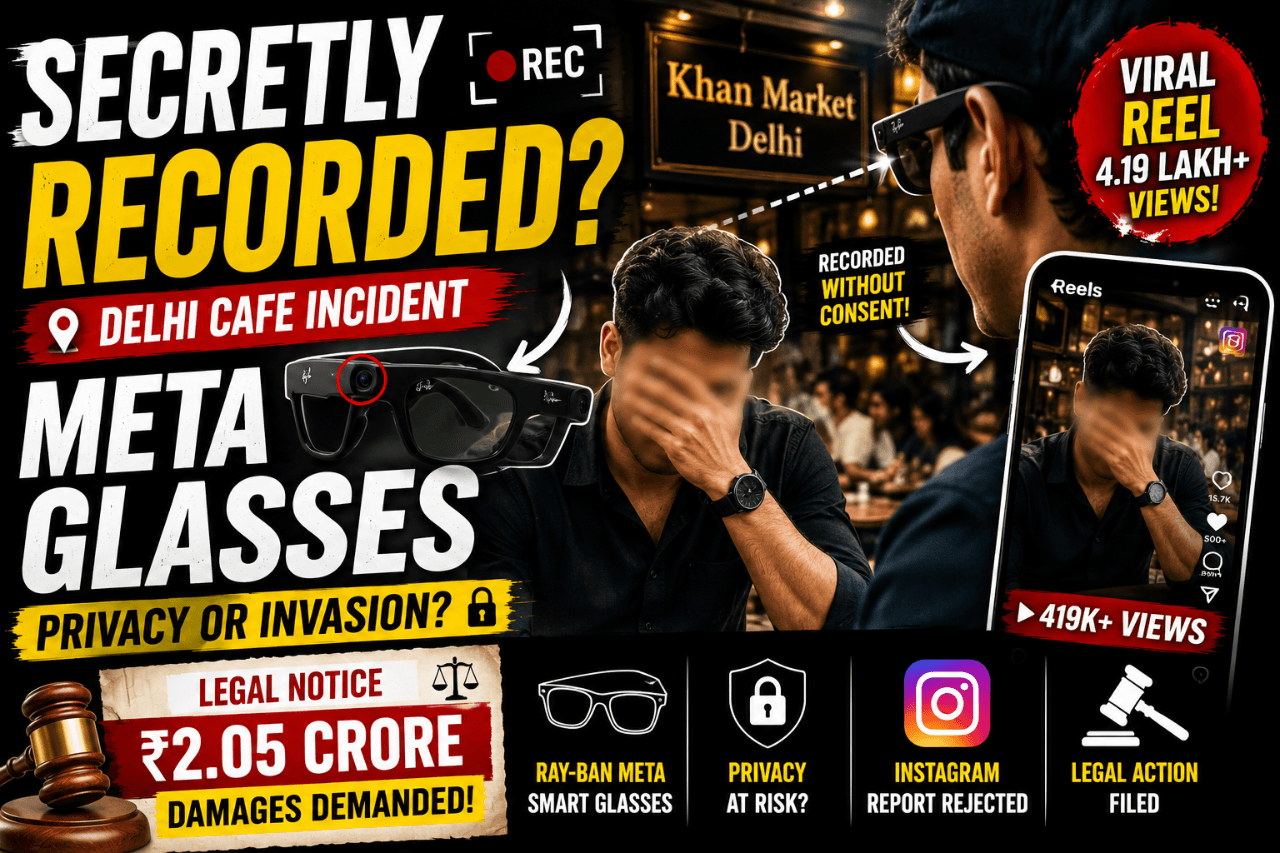
According to the Internet Freedom Foundation (IFF), which is providing the man with pro bono legal assistance, the incident took place on July 24, 2026 at a café in Delhi's Khan Market.
The man, whose identity has been withheld and is referred to as “X”, alleges that an Instagram creator approached him while he was sitting alone and subjected him to unsolicited questions and remarks.
He says he eventually moved to another seating area after complaining to café staff.
What he allegedly did not know was that the interaction was being recorded.
How was he allegedly recorded?
According to the legal notice, the creator was wearing camera-equipped Ray-Ban Meta smart glasses.
Unlike someone visibly holding a smartphone camera, smart glasses can capture video from the wearer's point of view while resembling ordinary eyewear.
The complainant alleges that he did not know the glasses were recording him.
The notice further alleges that one or more associates of the creator recorded the interaction from additional angles.
These claims have not yet been tested or decided by a court.
What happened to the video?
According to IFF, footage of the encounter was uploaded to Instagram as a Reel on July 26.
By August 6, IFF says the Reel had crossed 4.19 lakh views, around 15,700 likes and more than 500 comments.
The complainant alleges that several comments mocked or ridiculed him, causing humiliation, distress and reputational harm.
He subsequently attempted to have the content removed.
What happened when he reported the Reel?
According to IFF, the man reported the Reel and Instagram account through Instagram's reporting system.
The legal notice claims that the reporting interface did not provide a specific category covering his complaint about privacy or non-consensual recording, so he selected “bullying or harassment” as the closest available option.
Instagram subsequently informed him that the reported material did not violate its Community Standards, according to IFF.
A review was also rejected.
The complainant additionally approached Meta's grievance officer in India, but IFF says that no acknowledgement or decision had been received when the legal notice was issued.
Why is he demanding ₹2.05 crore?
A legal notice dated August 24 seeks ₹2.05 crore in damages.
It also demands the removal of the disputed video, an apology, preservation and disclosure of relevant evidence and other remedies.
But an important distinction needs to be made.
This is a demand contained in a legal notice. It does not mean that a court has ordered Meta or the creator to pay ₹2.05 crore.
The allegations and questions of liability remain unresolved.
Why has Meta been named?
This is what makes the dispute particularly interesting.
The notice does not focus only on the person who allegedly recorded and uploaded the interaction.
It also seeks to hold Meta responsible.
One part concerns Instagram and the way the complainant says his reports were handled.
The other concerns the design of the Ray-Ban Meta smart glasses themselves.
IFF says this may be among the first legal actions in India attempting to hold a smart-glasses manufacturer responsible for harm allegedly enabled by the design of such a device.
Don't Meta glasses show when they are recording?
Ray-Ban Meta glasses include a front-facing capture indicator designed to illuminate while the camera is being used.
The legal notice, however, argues that this indicator can be easily overlooked by a bystander who may not even realise that the eyewear contains a camera.
That argument is central to the dispute.
It raises a broader question: is simply providing a recording indicator enough when the camera itself is integrated into something that looks like normal eyewear?
That question has not been decided in this case.
Why does this story matter?
Smart glasses change one of the most obvious signals people traditionally associate with being filmed.
When someone raises a smartphone and points its camera toward you, recording can often be obvious.
With camera-equipped glasses, recording can happen from the wearer's point of view without the same visible gesture.
As wearable cameras become more common, disputes like this could become important tests of how privacy, consent, product design and social-media moderation interact.
What you should know
A Delhi man has sent a legal notice seeking ₹2.05 crore in damages after alleging that an Instagram creator secretly recorded him using Ray-Ban Meta smart glasses at a Khan Market café.
The footage was subsequently uploaded to Instagram and, according to IFF, crossed 4.19 lakh views.
The notice seeks to hold Meta accountable not only over Instagram's handling of the content but also over alleged privacy risks associated with the design of its smart glasses.
However, the claims remain allegations.
No court has yet ruled that Meta or the creator is liable, nor has a court awarded the complainant ₹2.05 crore.
The larger question raised by the dispute may ultimately be even more important: when a camera can look almost like ordinary eyewear, how should people know when they are being recorded?